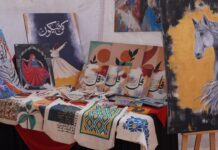


“I never knew how much planning goes into a single exhibition until I saw it happening live at PNCA”, a Computer Science student reflected during a recent field visit. That observation captures the essence of the UOR Students PNCA Visit, which offered undergraduate students from Computer Science and Digital Design a rare opportunity to experience community engagement, contemporary art, and professional exhibition management beyond the classroom.
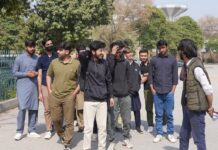
As part of experiential learning initiatives at University of Rawalpindi, undergraduate students from Computer Science (CS) and Digital Design and Computer Arts (DDCA) visited the Pakistan National Council of Arts (PNCA). Although their academic disciplines differ, the visit created a shared learning space where art, civic responsibility, and professional event management intersected.
This UOR students PNCA visit offered valuable real-world exposure to art, civic engagement, and professional exhibition management.
Why This Visit Matters
Globally, universities are increasingly integrating student-centered learning and active learning techniques into their curricula. According to UNESCO, experiential learning, often described as learning by doing, is a core element of transformative education. It equips learners with critical thinking, teamwork, and communication skills, while fostering civic awareness and improving readiness for the labor market.
In Pakistan, such exposure is particularly valuable, as students often remain confined to classroom-based or tool-driven instruction.
For UOR students, the PNCA visit addressed two key gaps: limited exposure to contemporary cultural practices and a lack of understanding of how large-scale public events are conceptualized, managed, and delivered. By stepping into a national cultural institution, students experienced how education connects with society beyond academic boundaries.
What Happened During the UOR Students PNCA Visit
Exploring Art, Media, and Civic Engagement:
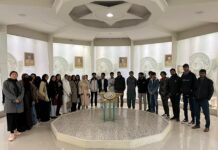
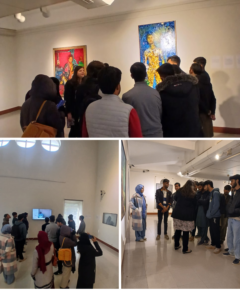
The visit took place under the academic supervision of Dr. Saniya Moazzam as part of the Civics and Community Engagement course. Students explored a live exhibition titled “Media Advisory: Event & Art Exhibition Opening to Mark ‘16 Days of Activism Against Gender-Based Violence”. Directed by Catherine Weibel, the exhibition used art and media to address sensitive social issues through professional curatorial and communication strategies.
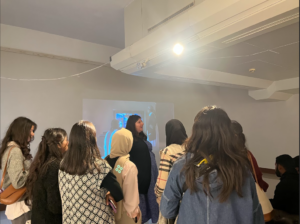
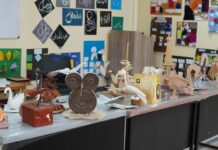
Alongside CS students, undergraduate DDCA students under the supervision of Ms. Aina Merzia from UOR participated in a parallel gallery visit focused on contemporary art practice. For many, this was their first experience inside a formal exhibition space.
Overall, the UOR Students PNCA Visit created a shared learning space where academic disciplines, cultural expression, and community engagement intersected meaningfully.
Seen and Unseen: Understanding Contemporary Art
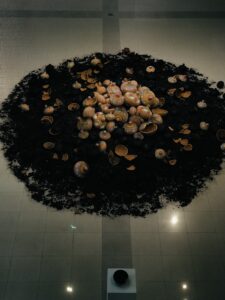
The exhibition “Seen and Unseen” centered on women’s issues, gender-based violence, and physical and mental wellbeing. Rather than relying on literal or graphic imagery, artists employed metaphor, abstraction, video installations, projections, performative art, and 3D printing to communicate layered social narratives.

This approach challenged students’ preconceived notions of art. Many initially assumed that artwork must be confined to a canvas, frame, or hardcopy format. Through guided observation and discussion, students began to understand that contemporary art prioritizes ideas, emotional engagement, and interpretation over fixed meanings.
The experience encouraged students to slow down, observe carefully, and reflect on how visual language can communicate complex realities without direct representation.
Learning Event and Exhibition Management
Behind-the-Scenes of Professional Exhibitions
Beyond artistic interpretation, Computer Science students focused on understanding the operational side of exhibitions. PNCA staff and the exhibition team explained key components of professional event and exhibition management, including:
• Theme selection aligned with social advocacy
• Exhibition layout and visitor flow planning
• Artist–curator coordination
• Media communication and public outreach
• Logistical planning and on-site execution
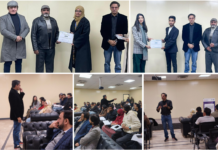
A particularly valuable learning moment came from direct interaction with Director Catherine Weibel, who shared insights into the behind-the-scenes planning required for awareness-focused exhibitions. Students learned that social impact events demand clarity of message, sensitivity to audiences, and strong coordination across teams.
Skills and Outcomes for Students
Under academic guidance, students developed a range of skills aligned with skills-focused higher education.
Transferable Skills Developed Through Active Learning:
• Event and exhibition planning: understanding timelines, roles, and coordination
• Communication skills: engaging professionally with curators, directors, and organizers
• Critical observation: interpreting visual narratives and conceptual art
• Teamwork and leadership: observing collaborative professional environments
• Civic awareness: recognizing how art institutions address social issues
For DDCA students, the visit expanded their understanding of digital design beyond software proficiency, encouraging them to explore socially engaged and concept-driven creative practices. For CS students, it demonstrated how technical learners can meaningfully contribute to community events and public engagement initiatives.
Interdisciplinary and Community Perspectives
An important dimension of the visit was its interdisciplinary nature. While the DDCA faculty emphasized contemporary art practice and visual expression, Dr. Saniya Moazzam’s engagement linked the experience to community awareness, civic responsibility, and public impact.
This dual academic lens helped students connect creative practice with broader societal concerns, reinforcing the idea that universities play a. critical role in shaping socially responsible professionals.
Connecting Local Learning with Global Trends
Internationally, art and media are increasingly used as tools for advocacy, dialogue, and social reflection. Exhibitions addressing gender-based violence and wellbeing align with global movements such as the UN’s “16 Days of Activism Against Gender-Based Violence”. Exposure to such initiatives allows students to understand how local cultural institutions contribute to global conversations within the context of higher education in Pakistan.
For UOR, experiences like the PNCA visit strengthen the university student experience by bridging theory with practice and aligning academic learning with real-world challenges.
Conclusion
This visit demonstrated that meaningful learning often happens beyond classroom walls. The UOR students PNCA visit demonstrated how experiential learning strengthens academic understanding, civic awareness, and interdisciplinary thinking.
Whether through interpreting conceptual artworks or understanding the logistics behind large-scale exhibitions, students learned that education is not only about technical competence or employability. It is also about perspective, awareness, and the ability to engage thoughtfully with society.
Call to action:
Explore more student-centered learning stories and academic initiatives on the UOR Blog to see how education at UOR connects classrooms with communities.